| Exam Name: | PECB Certified ISO/IEC 27001 2022 Lead Auditor exam | ||
| Exam Code: | ISO-IEC-27001-Lead-Auditor Dumps | ||
| Vendor: | PECB | Certification: | ISO 27001 |
| Questions: | 418 Q&A's | Shared By: | sonia |
Scenario 7
Lawsy is a leading law firm with offices in Bangkok, Thailand. It has over 50 attorneys offering sophisticated legal services to clients in business and commercial law, intellectual property, banking, and financial services. They believe they have a comfortable position in the market thanks to their commitment to implementing information security best practices and remaining up to date with technological developments.
Lawsy has rigorously implemented, evaluated, and conducted internal audits for the information security management system (ISMS) for two years. Now, they have applied for ISO/IEC 27001 certification at ISMA, a well-known and trusted certification body.
During the stage 1 audit, the audit team reviewed all the ISMS documents created during the implementation phase. They also reviewed and evaluated the records from management reviews and internal audits. Lawsy submitted records of evidence that corrective actions on nonconformities were performed when necessary, so the audit team interviewed the internal auditor. The interview validated the adequacy and frequency of the internal audits by providing insight into the internal audit plan and procedures.
The audit team continued verifying strategic documents, including the information security policy and risk evaluation criteria. During the information security policy review, the team noticed inconsistencies between the documented information describing the governance framework and the procedures. Following the completion of stage 1, the audit team leader prepared the audit plan, which addressed the audit objectives, scope, criteria, and procedures.
During the stage 2 audit, the audit team interviewed the information security manager, who drafted the information security policy. He justified the issue identified in stage 1 by stating that Lawsy conducts mandatory information security training and awareness sessions every three months.
Later, the audit team found that Lawsy did not have procedures for using laptops outside the workplace, even though employees were allowed to take laptops outside the workplace. The company only provided general information about the use of laptops and relied on employees’ common knowledge to protect the confidentiality and integrity of information stored on the laptops.
Following the interview, the audit team examined 15 employee training records (out of 50) and concluded that Lawsy meets the requirements of ISO/IEC 27001 related to training and awareness. To support this conclusion, the auditor photocopied and archived the examined employee training records after completing the audit.
Question
During the audit, the team reviewed a sample of training records from 15 out of 50 employees. What does this situation represent? Refer to the scenario.
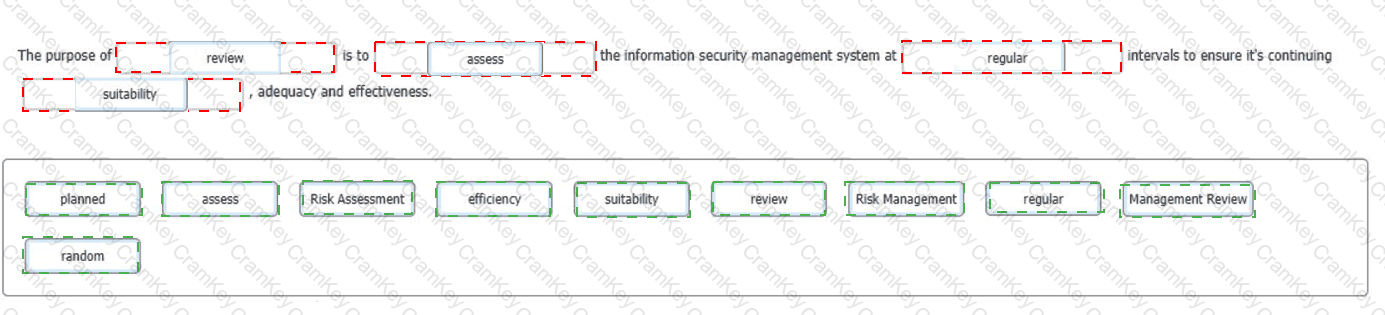
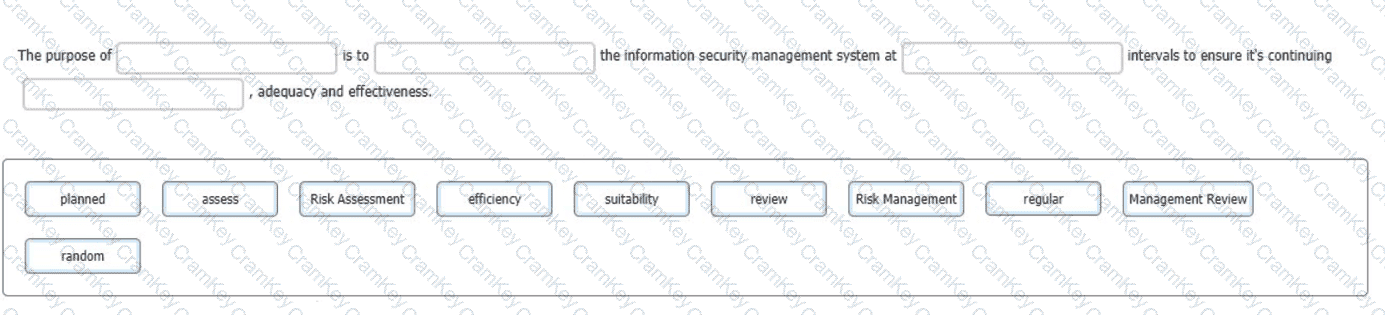
You are an experienced ISMS audit team leader, talking to an Auditor in training who has been assigned to your audit team. You want to ensure that they understand the importance of the Check stage of the Plan-Do-Check-Act cycle in respect of the operation of the information security management system.
You do this by asking him to select the words that best complete the sentence:
To complete the sentence with the best word(s), click on the blank section you want to complete so that it is highlighted in red, and then click on the applicable text from the options below. Alternatively, you may drag and drop the option to the appropriate blank section.
Scenario 2:
Clinic, founded in the 1990s, is a medical device company that specializes in treatments for heart-related conditions and complex surgical interventions. Based in Europe, it serves both patients and healthcare professionals. Clinic collects patient data to tailor treatments, monitor outcomes, and improve device functionality. To enhance data security and build trust, Clinic is implementing an information security management system (ISMS) based on ISO/IEC 27001. This initiative demonstrates Clinic's commitment to securely managing sensitive patient information and proprietary technologies.
Clinic established the scope of its ISMS by solely considering internal issues, interfaces, dependencies between internal and outsourced activities, and the expectations of interested parties. This scope was carefully documented and made accessible. In defining its ISMS, Clinic chose to focus specifically on key processes within critical departments such as Research and Development, Patient Data Management, and Customer Support.
Despite initial challenges, Clinic remained committed to its ISMS implementation, tailoring security controls to its unique needs. The project team excluded certain Annex A controls from ISO/IEC 27001 while incorporating additional sector-specific controls to enhance security. The team evaluated the applicability of these controls against internal and external factors, culminating in the development of a comprehensive Statement of Applicability (SoA) detailing the rationale behind control selection and implementation.
As preparations for certification progressed, Brian, appointed as the team leader, adopted a self-directed risk assessment methodology to identify and evaluate the company’s strategic issues and security practices. This proactive approach ensured that Clinic’s risk assessment aligned with its objectives and mission.
Question:
Based on Scenario 2, the Clinic decided that the ISMS would cover only key processes and departments. Is this acceptable?

TESTED 23 Oct 2026