Full packet capture requires the largest amount of storage space because it involves recording all packets that pass through a network, including all headers and payloads. This type of data collection is comprehensive and allows for detailed analysis, but due to the volume of data it encompasses, it demands significant storage capacity1.
References := The Cisco Secure Network Analytics Data Store Design Guide discusses the storage requirements for different types of network data collection, highlighting the substantial storage needs for full packet captures1.
Question 81
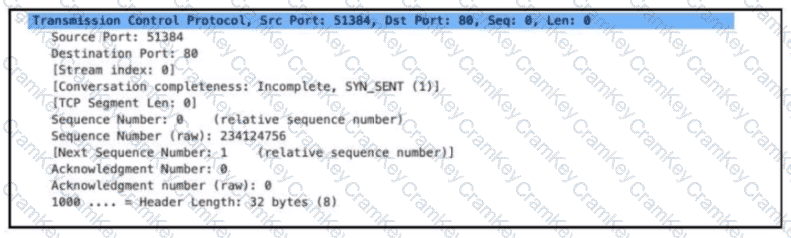
Refer to the exhibit. Which alert is identified from this packet?

A threat is a possible danger that might exploit a vulnerability to breach the security and cause harm to an asset. An asset is anything of value that needs to be protected, such as data, systems, or networks. A vulnerability is a weakness or flaw in the security that can beexploited by a threat. An exploit is a piece of code or a technique that takes advantage of a vulnerability to compromise the security and perform malicious actions on an asset. References := Cisco Cybersecurity Operations Fundamentals, Module 1: Security Concepts, Lesson 1.1: The CIA Triad and Security Concepts, Topic 1.1.3: Threats, Vulnerabilities, and Exploits
Question 83
What is a difference between SIEM and SOAR?
Options:
A.
SOAR predicts and prevents security alerts, while SIEM checks attack patterns and applies the mitigation.
B.
SlEM's primary function is to collect and detect anomalies, while SOAR is more focused on security operations automation and response.
C.
SIEM predicts and prevents security alerts, while SOAR checks attack patterns and applies the mitigation.
D.
SOAR's primary function is to collect and detect anomalies, while SIEM is more focused on security operations automation and response.
SIEM (Security Information and Event Management) systems are solutions that provide real-time analysis of security alerts generated by applications and network hardware. They collect, store, analyze, and report on log data for incident response, forensics, and regulatory compliance. On the other hand, SOAR (Security Orchestration Automation and Response) platforms allow organizations to collect data about security threats from multiple sources and respond to low-level security events without human assistance. References: Cisco Cybersecurity Operations Fundamentals