The correct answer is A .
In AgilePM, when there is a disagreement between business value and solution risk , the best response is not to immediately side with one party, nor to force a premature decision. Instead, the Project Manager should facilitate collaborative decision-making so that the relevant roles can assess value, feasibility, risks, and trade-offs together.
That is exactly what Option A does.
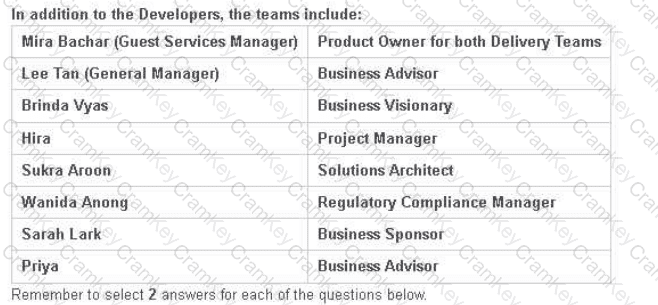
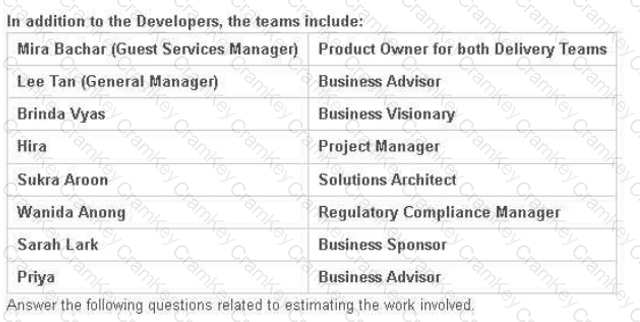
Brinda, as the Business Visionary , is focused on ensuring that the Eco-spa experience delivers the intended holistic wellness value. From her perspective, the meditation garden may be an important part of the guest experience and brand promise.
Sukra, as the Solution Architect , is responsible for ensuring the integrity, quality, and feasibility of the solution. His concern about cultivating and maintaining the required plants is legitimate because it relates to delivery feasibility, sustainability, operational burden, and long-term viability.
Hira, as the Project Manager , should not resolve this by taking sides too early. Her role is to create the conditions for an informed decision by bringing the right people together, clarifying the issue, and helping them assess both:
the business value of including the garden, and
the delivery and operational risks associated with it.
Why A is correct:
A facilitated workshop is the most AgilePM-aligned response because it:
encourages collaboration between business and technical roles ,
supports shared understanding of benefits, constraints, and risks ,
enables informed decision-making based on evidence and discussion,
allows stakeholders to explore alternatives or compromises,
and reflects agile leadership through facilitation rather than command-and-control.
In a workshop, the group could discuss questions such as:
Is the meditation garden truly essential for minimum usable business value?
Are there lower-risk alternatives that still achieve the same wellness outcome?
Can plant selection, design changes, or maintenance plans reduce the risk?
Does the value justify the cost and complexity?
Should it be deferred, simplified, or prototyped first?
This is exactly the sort of balanced evaluation AgilePM encourages.
Why the other options are incorrect:
B. Support Sukra ' s perspective to minimize any additional architectural and maintenance risks.
This is incorrect because it means Hira would be prematurely siding with the technical perspective without properly considering the business value. AgilePM requires balance between feasibility and business need. Risk matters, but so does value.
C. Prioritize the garden as a Must Have, allocating resources to manage the risks.
This is incorrect because it assumes the garden should automatically be treated as a Must Have. In AgilePM, prioritization should be based on agreed business value, urgency, and feasibility, not on one stakeholder’s preference alone. Also, making it a Must Have before evaluating the risks properly would be poor governance.
D. Remind Brinda and Sukra of their roles, Brinda defines needs, Sukra decides how to deliver them.
This option contains a partial truth about role boundaries, but it is not the best way to resolve the conflict. While Brinda does represent business needs and Sukra advises on solution design, this is too simplistic for a situation involving risk, value, and potential trade-offs. AgilePM encourages collaboration, not rigid role-based separation as the primary conflict resolution mechanism.
AgilePM perspective:
AgilePM places strong emphasis on:
active business involvement
collaborative decision-making
fitness for business purpose
iterative exploration of value and risk
facilitative leadership
When tension arises between a desired feature and implementation risk, the right response is to evaluate the issue collaboratively rather than allowing either business ambition or technical caution to dominate without discussion.
In this scenario, the meditation garden may indeed add significant value to the guest wellness experience, but it may also introduce environmental, operational, and sustainability concerns. The best AgilePM response is therefore to explore the trade-off through structured collaboration.
So, from an AgilePM standpoint, A is the best answer because Hira should facilitate a discussion that assesses both potential value and associated risks before deciding how to proceed.