Pre-Summer Sale Limited Time 65% Discount Offer - Ends in 0d 00h 00m 00s - Coupon code: get65

Databricks Updated Databricks-Certified-Professional-Data-Engineer Exam Questions and Answers by izabella

Page: 10 / 14

Databricks Databricks-Certified-Professional-Data-Engineer Exam Overview :

Exam Name: Databricks Certified Data Engineer Professional Exam
Exam Code: Databricks-Certified-Professional-Data-Engineer Dumps
Vendor: Databricks Certification: Databricks Certification
Questions: 202 Q&A's Shared By: izabella
Question 40

Where in the Spark UI can one diagnose a performance problem induced by not leveraging predicate push-down?

Options:

A.

In the Executor ' s log file, by gripping for " predicate push-down "

B.

In the Stage ' s Detail screen, in the Completed Stages table, by noting the size of data read from the Input column

C.

In the Storage Detail screen, by noting which RDDs are not stored on disk

D.

In the Delta Lake transaction log. by noting the column statistics

E.

In the Query Detail screen, by interpreting the Physical Plan

Discussion
Question 41

A data engineering team is migrating off its legacy Hadoop platform. As part of the process, they are evaluating storage formats for performance comparison. The legacy platform uses ORC and RCFile formats. After converting a subset of data to Delta Lake , they noticed significantly better query performance. Upon investigation, they discovered that queries reading from Delta tables leveraged a Shuffle Hash Join , whereas queries on legacy formats used Sort Merge Joins . The queries reading Delta Lake data also scanned less data.

Which reason could be attributed to the difference in query performance?

Options:

A.

Delta Lake enables data skipping and file pruning using a vectorized Parquet reader.

B.

The queries against the Delta Lake tables were able to leverage the dynamic file pruning optimization.

C.

Shuffle Hash Joins are always more efficient than Sort Merge Joins.

D.

The queries against the ORC tables leveraged the dynamic data skipping optimization but not the dynamic file pruning optimization.

Discussion
Question 42

The business reporting team requires that data for their dashboards be updated every hour. The total processing time for the pipeline that extracts, transforms, and loads the data for their pipeline runs in 10 minutes. Assuming normal operating conditions, which configuration will meet their service-level agreement requirements with the lowest cost?

Options:

A.

Schedule a job to execute the pipeline once an hour on a dedicated interactive cluster.

B.

Schedule a job to execute the pipeline once an hour on a new job cluster.

C.

Schedule a Structured Streaming job with a trigger interval of 60 minutes.

D.

Configure a job that executes every time new data lands in a given directory.

Discussion
Anya
I must say they're considered the best dumps available and the questions are very similar to what you'll see in the actual exam. Recommended!!!
Cassius May 2, 2026
Yes, they offer a 100% success guarantee. And many students who have used them have reported passing their exams with flying colors.
Miley
Hey, I tried Cramkey Dumps for my IT certification exam. They are really awesome and helped me pass my exam with wonderful score.
Megan May 25, 2026
That’s great!!! I’ll definitely give it a try. Thanks!!!
Syeda
I passed, Thank you Cramkey for your precious Dumps.
Stella May 2, 2026
That's great. I think I'll give Cramkey Dumps a try.
Madeleine
Passed my exam with my dream score…. Guys do give these dumps a try. They are authentic.
Ziggy May 7, 2026
That's really impressive. I think I might give Cramkey Dumps a try for my next certification exam.
Question 43

A junior data engineer has been asked to develop a streaming data pipeline with a grouped aggregation using DataFrame df . The pipeline needs to calculate the average humidity and average temperature for each non-overlapping five-minute interval. Events are recorded once per minute per device.

Streaming DataFrame df has the following schema:

" device_id INT, event_time TIMESTAMP, temp FLOAT, humidity FLOAT "

Code block:
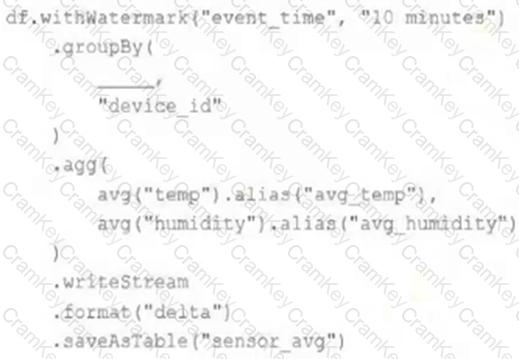
Questions 43

Choose the response that correctly fills in the blank within the code block to complete this task.

Options:

A.

to_interval( " event_time " , " 5 minutes " ).alias( " time " )

B.

window( " event_time " , " 5 minutes " ).alias( " time " )

C.

" event_time "

D.

window( " event_time " , " 10 minutes " ).alias( " time " )

E.

lag( " event_time " , " 10 minutes " ).alias( " time " )

Discussion
Page: 10 / 14
Title
Questions
Posted

Databricks-Certified-Professional-Data-Engineer
PDF

$36.75  $104.99

Databricks-Certified-Professional-Data-Engineer Testing Engine

$43.75  $124.99

Databricks-Certified-Professional-Data-Engineer PDF + Testing Engine

$57.75  $164.99