Month End Sale Limited Time 70% Discount Offer - Ends in 0d 00h 00m 00s - Coupon code: cram70off

Cisco Updated 300-610 Exam Questions and Answers by aden

Page: 8 / 22

Cisco 300-610 Exam Overview :

Exam Name: Designing Cisco Data Center Infrastructure for Traditional and AI Workloads v1.2 (DCID 300-610)
Exam Code: 300-610 Dumps
Vendor: Cisco Certification: CCNP Data Center
Questions: 299 Q&A's Shared By: aden
Question 32

Questions 32

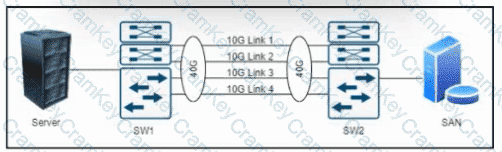
Refer to the exhibit. A 4x10G Fibre Channel has been configured between SW1 and SW2 to carry backup traffic sourced to and from the SAN. An engineer noticed that 10G Link 1 is being used more heavily than the other links within the port channel. Which action must the engineer take on the two switches to ensure that the traffic uses all available links between SW1 and SW2?

Options:

A.

Configure exchange-based load-balancing.

B.

Configure flow-based load-balancing.

C.

Configure src-dst-ip-based load-balancing.

D.

Configure dst-mac-based load-balancing.

Discussion
Question 33

A data center with high traffic demand is experiencing insufficient link throughput, congestion, and performance degradation. A network engineer has already enabled Priority Flow Control and jumbo frames on all data-center network devices, but further improvement is required. The solution must follow IEEE 802.1AX and IEEE 802.3ad principles. Which action must the engineer take?

Options:

A.

Implement DCBX with Enhanced Transmission Selection to provide granular bandwidth allocation.

B.

Implement hierarchical QoS to classify and prioritize traffic according to application criticality and bandwidth requirements.

C.

Upgrade the network to 10-GbE or 40-GbE links.

D.

Implement vPC link aggregation to increase aggregate bandwidth and provide redundancy.

Discussion
Question 34

To help automate the vHBA configuration process, a network engineer is configuring vHBA template pairs on UCS The engineer is creating primary and secondary templates to define how vHBAs on a server connect to the SAN. Which fact about the template pair should the engineer consider for Its potential impact on service7

Options:

A.

The QoS policy configuration will not be shared between the two templates

B.

The description configuration will be shared between the two templates

C.

The WWPN pool configuration will not be shared between the two templates.

D.

The fabric ID configuration will be shared between the two templates

Discussion
Ilyas
Definitely. I felt much more confident and prepared because of the Cramkey Dumps. I was able to answer most of the questions with ease and I think that helped me to score well on the exam.
Saoirse Jul 4, 2026
That's amazing. I'm glad you found something that worked for you. Maybe I should try them out for my next exam.
Lennox
Something Special that they provide a comprehensive overview of the exam content. They cover all the important topics and concepts, so you can be confident that you are well-prepared for the test.
Aiza Jul 5, 2026
That makes sense. What makes Cramkey Dumps different from other study materials?
Reeva
Wow what a success I achieved today. Thank you so much Cramkey for amazing Dumps. All students must try it.
Amari Jul 26, 2026
Wow, that's impressive. I'll definitely keep Cramkey in mind for my next exam.
Wyatt
Passed my exam… Thank you so much for your excellent Exam Dumps.
Arjun Jul 14, 2026
That sounds really useful. I'll definitely check it out.
Lennie
I passed my exam and achieved wonderful score, I highly recommend it.
Emelia Jul 23, 2026
I think I'll give Cramkey a try next time I take a certification exam. Thanks for the recommendation!
Question 35

A network administrator must simplify and optimize the VRF architecture in a Cisco ACI fabric. The current deployment contains multiple tenants, each with its own network stack, and uses VRF leaking for inter-tenant communication. The large number of tenants and leaked routes is causing the switches to approach their prefix-capacity limits. Which solution should the engineer recommend?

Options:

A.

Collapse all VRFs into a single VRF in the management tenant.

B.

Collapse all VRFs into multiple VRFs in the management tenant and continue using VRF leaking.

C.

Collapse all VRFs into multiple VRFs in the common tenant and continue using VRF leaking.

D.

Collapse all VRFs into a single VRF in the common tenant.

Discussion
Page: 8 / 22
Title
Questions
Posted

300-610
PDF

$34.5  $114.99

300-610 Testing Engine

$40.5  $134.99

300-610 PDF + Testing Engine

$52.5  $174.99