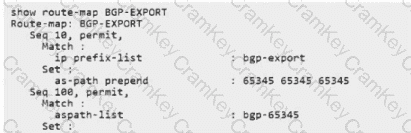
The exhibit shows a configuration for a Route Map named BGP-EXPORT. To identify the correct statement, we must analyze the specific BGP attributes being manipulated in the sequence entries.
Analyzing Sequence 10:
Match: It looks for network prefixes defined in an IP prefix-list named bgp-export.
Set: It executes the command as-path prepend 65345 65345 65345.
AS Path Prepending: In BGP, the " Shortest AS Path " is one of the primary decision factors in the Best Path Selection Algorithm. AS Path Prepending is a technique used by network administrators to make a specific route appear " less desirable " to external neighbors. By adding multiple instances of an AS number (in this case, AS 65345 is added three times) to the existing AS Path, the switch artificially increases the length of the path.
Conclusion for Statement B: Because the route map prepends the AS path for the matched prefixes, the resulting BGP update sent to neighbors will contain an AS path that is significantly longer than the default (which would normally just include the local AS). Therefore, statement B is true.
Evaluating other options:
Option A: This is technically incorrect syntax. Route maps are applied to BGP neighbors using the command neighbor [IP] route-map BGP-EXPORT out (for export) or in (for import). There is no " remote-as export " command for binding route maps.
Option C: There is no set metric or set med command visible in the output. MED (Multi-Exit Discriminator) is a different attribute used to influence inbound traffic from an adjacent AS.
Option D: This is a conceptual error. IP prefix-lists are used to match IP addresses and subnet masks (the " prefixes " ). AS Path Lists (as seen in Seq 100) or regular expressions are used to match AS paths. You do not configure the path itself inside a prefix-list.