Comprehensive and Detailed Explanation
HPE Press guide context | PDF page 609 | HPE Press, Aruba Certified Associate – Campus Access Official Certification Study Guide
Technical Deep Dive — Original Chat Wording
Domain Name System (DNS) is a foundational network service that translates hostnames into IP addresses.
HPE Aruba Networking Central-managed devices commonly communicate with cloud services identified by fully qualified domain names.
DNS resolution enables a device to identify the IP addresses associated with those management-service endpoints.
For example, a switch may need to resolve the hostname of an Aruba Central service before establishing its management connection.
Without functioning name resolution, hostname-based service connections may fail even when ordinary IP routing is operational.
AOS-CX supports explicit DNS server configuration through commands such as:
configure terminal
ip dns server-address 10.254.1.21
Administrators should verify DNS reachability, default routing, and permitted outbound connectivity.
SSH provides secure command-line management but is not the hostname-resolution service used to locate Central endpoints.
Syslog delivers event records to logging destinations.
SNMP supports device monitoring and management information exchange.
Neither Syslog nor SNMP substitutes for DNS.
An important distinction is that the study-guide version of the AOS-CX Central client includes a default DNS resolver for its own cloud communication.
Therefore, a manually configured global DNS server is not universally required in every supported deployment.
Nevertheless, working DNS resolution remains important when Central services are identified through hostnames.
Therefore, Option B (DNS for name resolution) is correct.
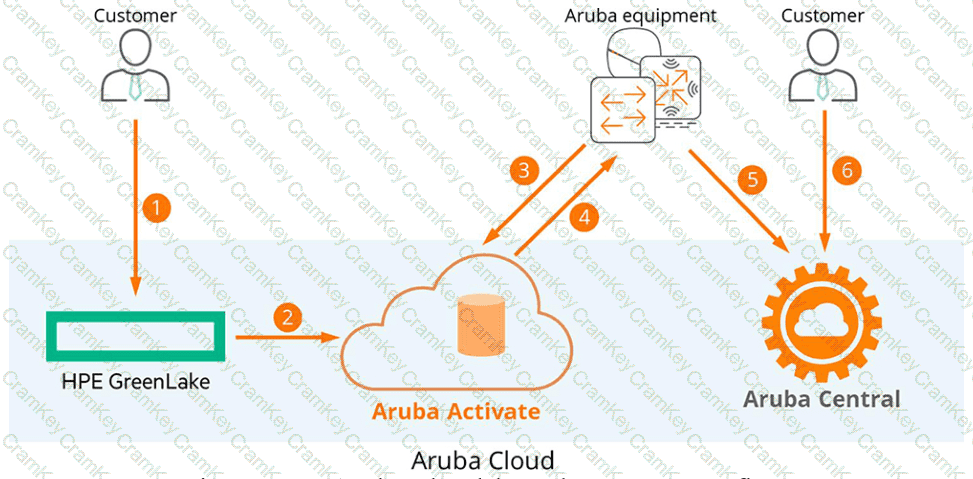
HPE Press study-guide figure / related learning illustration · Q148 Fig 7-7 Central