Comprehensive and Detailed Explanation
HPE Press guide context | PDF page 1033 | HPE Press, Aruba Certified Associate – Campus Access Official Certification Study Guide
Technical Deep Dive — Original Chat Wording
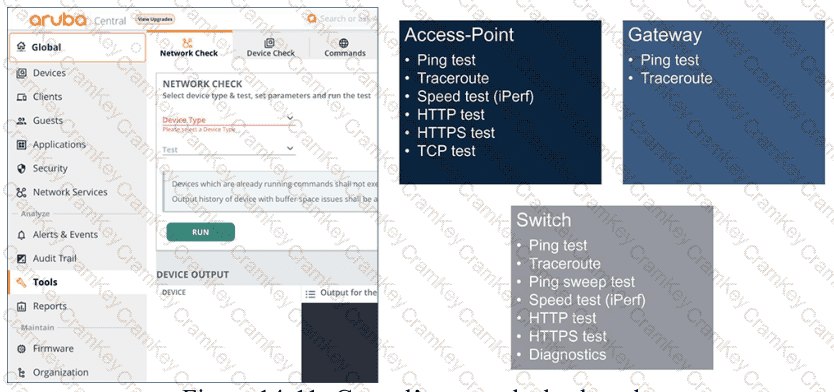
A network speed test evaluates the transfer performance observed between a testing endpoint and a selected destination.
Common measurements include download throughput, upload throughput, and sometimes connection latency.
Throughput represents the quantity of data successfully transferred during a specified period.
For example, a wireless laptop associated at a high physical-layer data rate may achieve substantially lower application throughput because of protocol overhead, channel contention, interference, or congestion.
Running a speed test helps determine the actual transfer performance experienced by the client.
Repeated tests can reveal performance variations during different periods of network utilization.
The location of the test server also affects the result.
A local test server can help isolate performance within the LAN, while an Internet-hosted test measures additional dependencies, including WAN connectivity and remote server capacity.
Speed tests do not directly identify damaged cables or faulty switch ports.
Physical-layer diagnosis requires appropriate interface counters, link information, and cable-testing tools.
Likewise, speed tests do not inventory all connected devices or map wireless coverage.
Those functions require different monitoring or discovery mechanisms.
Therefore, Option A (It measures current network performance) is correct.
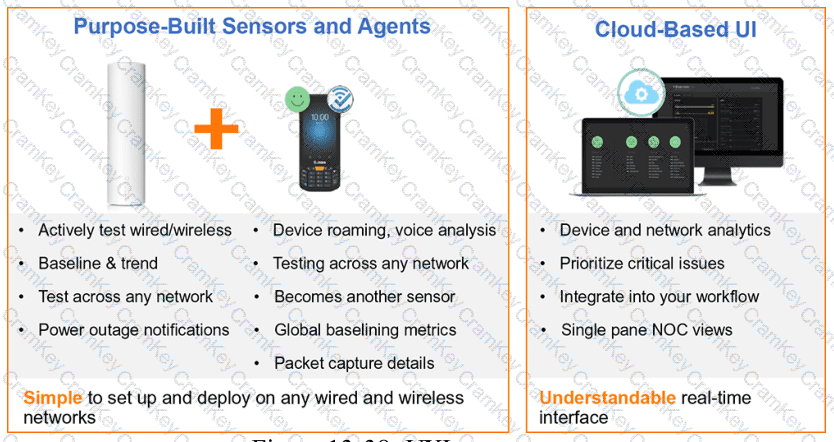
HPE Press study-guide figure / related learning illustration · Q155 Fig 13-38 UXI