Exhibit item
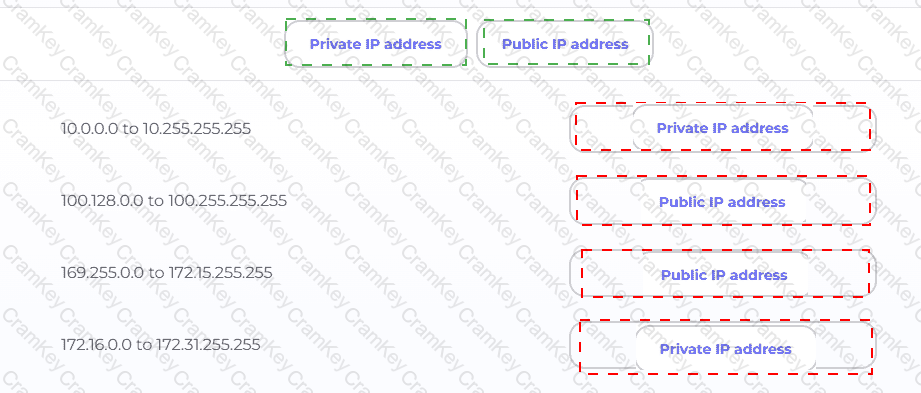
Correct match
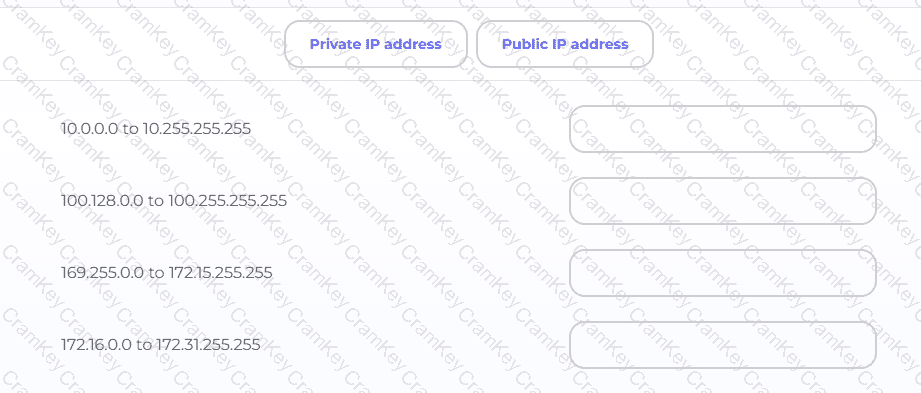
10.0.0.0 to 10.255.255.255
Private
100.128.0.0 to 100.255.255.255
Public (non-RFC1918)
169.255.0.0 to 172.15.255.255
Public (non-RFC1918)
172.16.0.0 to 172.31.255.255
Private
Comprehensive and Detailed Explanation
HPE Press guide context | PDF page 922 | HPE Press, Aruba Certified Associate – Campus Access Official Certification Study Guide
Technical Deep Dive — Original Chat Wording
IPv4 addresses are classified according to their allocation and intended use. RFC 1918 defines three address blocks reserved for private networks.
These addresses can be used internally without being globally unique across organizations. However, they are not intended to be routed directly across the public Internet.
The range 10.0.0.0–10.255.255.255 corresponds to 10.0.0.0/8 , making it private.
The range 172.16.0.0–172.31.255.255 corresponds to 172.16.0.0/12 , also making it private.
The address block 100.128.0.0–100.255.255.255 is outside the RFC 1918 private ranges. It is also outside the special shared-address block 100.64.0.0/10 , used for carrier-grade NAT. It is therefore classified as public address space for this question.
Similarly, 169.255.0.0–172.15.255.255 lies outside the RFC 1918 private blocks. Notably, the IPv4 link-local range is 169.254.0.0/16 , which is not included here.
Private addresses typically require Network Address Translation (NAT) when accessing public Internet resources.
The central principle is that addresses beginning with 172 are not automatically private; only 172.16.0.0/12 is reserved under RFC 1918.
Therefore, the correct sequence is Private, Public, Public, Private .
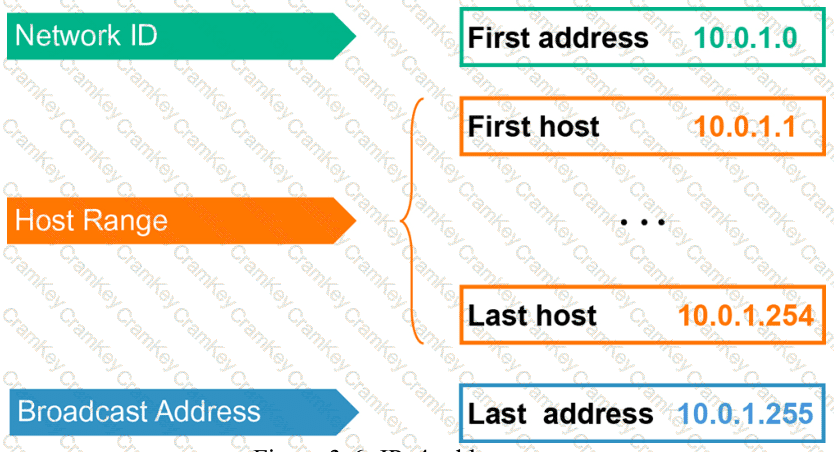
HPE Press study-guide figure / related learning illustration · Q151 Fig 3-6 IP types