A predict request is a way to send data to a trained model and get predictions in return. A predict request can be written in different formats, such as JSON, protobuf, or gRPC, depending on the service and the platform that are used to host and serve the model. A predict request usually contains the following information:
The signature name: This is the name of the signature that defines the inputs and outputs of the model. A signature is a way to specify the expected format, type, and shape of the data that the model can accept and produce. A signature can be specified when exporting or saving the model, or it can be automatically inferred by the service or the platform. A model can have multiple signatures, but only one can be used for each predict request.
The instances: This is the data that is sent to the model for prediction. The instances can be a single instance or a batch of instances, depending on the size and shape of the data. The instances should match the input specification of the signature, such as the number, name, and type of the input tensors.
For the use case of training a text classification model, the correct way to write the predict request is D. data = json.dumps({“signature_name”: “serving_default”, “instances”: [[‘a’, ‘b’], [‘c’, ‘d’] , [‘e’, ‘f’]]})
This option involves writing the predict request in JSON format, which is a common and convenient format for sending and receiving data over the web. JSON stands for JavaScript Object Notation, and it is a way to represent data as a collection of name-value pairs or an ordered list of values. JSON can be easily converted to and from Python objects using the json module.
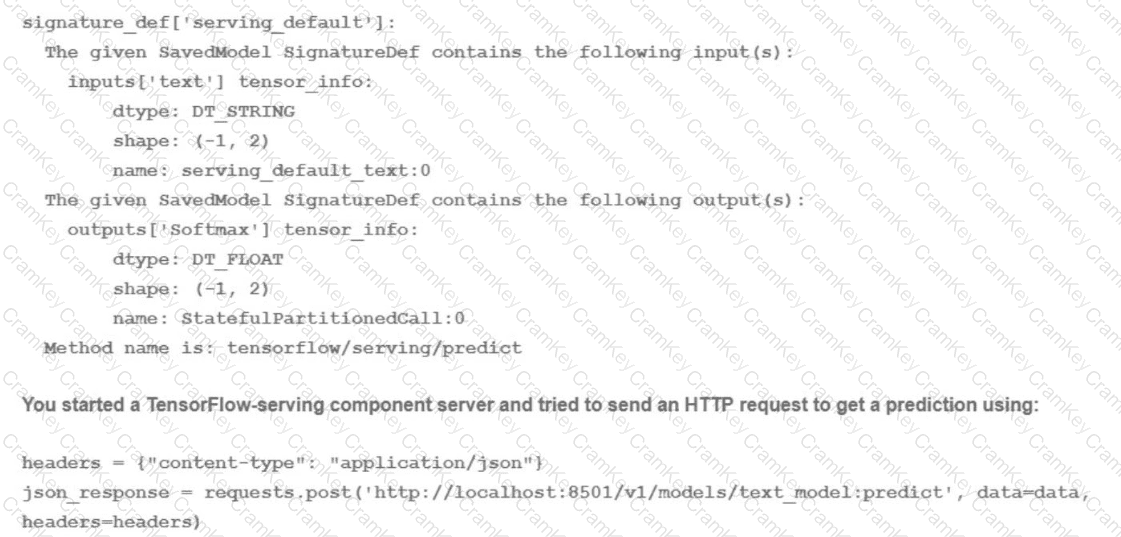
This option also involves using the signature name “serving_default”, which is the default signature name that is assigned to the model when it is saved or exported without specifying a custom signature name. The serving_default signature defines the input and output tensors of the model based on the SignatureDef that is shown in the image. According to the SignatureDef, the model expects an input tensor called “text” that has a shape of (-1, 2) and a type of DT_STRING, and produces an output tensor called “softmax” that has a shape of (-1, 2) and a type of DT_FLOAT. The -1 in the shape indicates that the dimension can vary depending on the number of instances, and the 2 indicates that the dimension is fixed at 2. The DT_STRING and DT_FLOAT indicate that the data type is string and float, respectively.
This option also involves sending a batch of three instances to the model for prediction. Each instance is a list of two strings, such as [‘a’, ‘b’], [‘c’, ‘d’] , or [‘e’, ‘f’]. These instances match the input specification of the signature, as they have a shape of (3, 2) and a type of string. The model will process these instances and produce a batch of three predictions, each with a softmax output that has a shape of (1, 2) and a type of float. The softmax output is a probability distribution over the two possible classes that the model can predict, such as positive or negative sentiment.
Therefore, writing the predict request as data = json.dumps({“signature_name”: “serving_default”, “instances”: [[‘a’, ‘b’], [‘c’, ‘d’] , [‘e’, ‘f’]]}) is the correct and valid way to send data to the text classification model and get predictions in return.