| Exam Name: | BIG-IP Administration Data Plane Configuration (F5CAB3) exam | ||
| Exam Code: | F5CAB3 Dumps | ||
| Vendor: | F5 | Certification: | F5-CA |
| Questions: | 86 Q&A's | Shared By: | orhan |
The BIG-IP Administrator is investigating whether better TCP performance is possible for a virtual server.
Which built-in profile should be tried first? (Choose one answer)
The BIG-IP Administrator has to provide encrypted communication between the users and the virtual server they access. Multiple hostnames are configured in DNS with the same IP address. Which profile type and setting in the profile should be used? (Choose one answer)
A BIG-IP Administrator creates a new Virtual Server to load balance SSH traffic. Users are unable to log on to the servers.
What should the BIG-IP Administrator do to resolve the issue?
Refer to the exhibit.
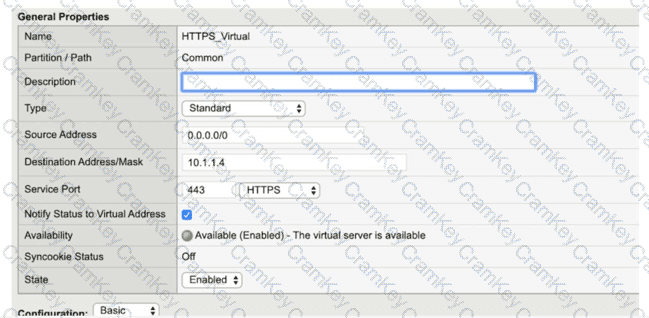
A BIG-IP Administrator configures a Virtual Server to handle HTTPS traffic. Users report that the application is NOT working. Which additional configuration is required to resolve this issue?

TESTED 14 Oct 2026

