Pre-Summer Sale Limited Time 65% Discount Offer - Ends in 0d 00h 00m 00s - Coupon code: get65

Page: 1 / 5

Network Security Administrator Palo Alto Networks Network Security Analyst

Palo Alto Networks Network Security Analyst

Last Update Apr 17, 2026
Total Questions : 74

To help you prepare for the NetSec-Analyst Paloalto Networks exam, we are offering free NetSec-Analyst Paloalto Networks exam questions. All you need to do is sign up, provide your details, and prepare with the free NetSec-Analyst practice questions. Once you have done that, you will have access to the entire pool of Palo Alto Networks Network Security Analyst NetSec-Analyst test questions which will help you better prepare for the exam. Additionally, you can also find a range of Palo Alto Networks Network Security Analyst resources online to help you better understand the topics covered on the exam, such as Palo Alto Networks Network Security Analyst NetSec-Analyst video tutorials, blogs, study guides, and more. Additionally, you can also practice with realistic Paloalto Networks NetSec-Analyst exam simulations and get feedback on your progress. Finally, you can also share your progress with friends and family and get encouragement and support from them.

Questions 2

A firewall administrator implementing Palo Alto Networks best practices on the company firewall reviews NGFW alerts in Strata Cloud Manager (SCM) and determines that one alert does not apply to this environment. If the administrator has no intention to resolve the underlying issue, what is the appropriate next step?

Options:

A.  

Click “Copilot” in the top right, and ask the Copilot to make an exception for the NGFW alert.

B.  

Assign the NGFW alert to the “Dismiss” user.

C.  

Change the NGFW alert priority to “Not Set.”

D.  

Open the NGFW alert and click “Suppress” under “Actions.”

Discussion 0
Questions 3

An analyst is investigating why an App-ID for a custom application is showing as "unknown-tcp" in the Traffic logs. The application is running on port 8080. What is the most likely cause of this identification failure?

Options:

A.  

The firewall does not have a signature for the proprietary application.

B.  

The Security policy is set to "application-default."

C.  

The traffic is being decrypted by an SSL Forward Proxy.

D.  

The URL category is "private-ip-addresses."

Discussion 0
Miriam
Highly recommended Dumps. 100% authentic and reliable. Passed my exam with wonderful score.
Milan Mar 21, 2026
I see. Thanks for the information. I'll definitely keep Cramkey in mind for my next exam.
Addison
Want to tell everybody through this platform that I passed my exam with excellent score. All credit goes to Cramkey Exam Dumps.
Libby Mar 7, 2026
That's good to know. I might check it out for my next IT certification exam. Thanks for the info.
Sarah
Yeah, I was so relieved when I saw that the question appeared in the exam were similar to their exam dumps. It made the exam a lot easier and I felt confident going into it.
Aaliyah Mar 15, 2026
Same here. I've heard mixed reviews about using exam dumps, but for us, it definitely paid off.
Esmae
I highly recommend Cramkey Dumps to anyone preparing for the certification exam.
Mollie Mar 27, 2026
Absolutely. They really make it easier to study and retain all the important information. I'm so glad I found Cramkey Dumps.
Questions 4

Based on the image below, what is a risk associated with this configuration?
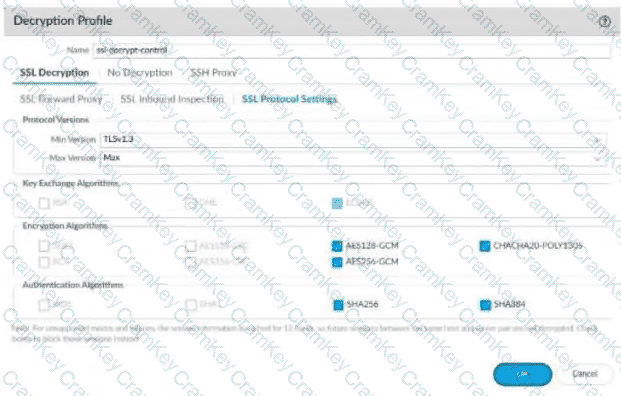
Questions 4

Options:

A.  

Min Version setting of TLSv1.3 can cause compatibility issues with legacy applications or clients.

B.  

Authentication algorithm selections can significantly increase resource consumption and cause performance degradation.

C.  

Encryption algorithms 3DES and RC4 being disabled decreases security posture.

D.  

Max Version setting of "Max" enables the use of Perfect Forward Secrecy (PFS) and cannot be decrypted.

Discussion 0
Questions 5

An analyst determines that several sanctioned, predefined applications are being intermittently blocked, even though there is an existing policy permitting them. An investigation reveals that the applications are using non-standard ports, which is causing them to be blocked. The applications are critical for business operations, and the analyst has approval to allow them.

Which configuration adjustment should be implemented to ensure secure access to the applications?

Options:

A.  

Apply Disable Server Response Inspection (DSRI) to the existing Security policy to allow the non-standard ports.

B.  

Disable App-ID and port filtering and rely solely on IP addresses of the applications to allow the non-standard ports.

C.  

Clone the existing Security policy rule and include the non-standard ports under services.

D.  

Clone the existing Security policy rule and include unknown-tcp and unknown-udp applications with service set to “any”

Discussion 0

NetSec-Analyst
PDF

$36.75  $104.99

NetSec-Analyst Testing Engine

$43.75  $124.99

NetSec-Analyst PDF + Testing Engine

$57.75  $164.99