New Year Special 75% Discount offer - Ends in 0d 00h 00m 00s - Coupon code: 75brite

Salesforce Updated MuleSoft-Integration-Architect-I Exam Questions and Answers by harper

Page: 17 / 20

Salesforce MuleSoft-Integration-Architect-I Exam Overview :

Exam Name: Salesforce Certified MuleSoft Platform Integration Architect (Mule-Arch-202)
Exam Code: MuleSoft-Integration-Architect-I Dumps
Vendor: Salesforce Certification: Salesforce MuleSoft
Questions: 273 Q&A's Shared By: harper
Question 68

A company is planning to extend its Mule APIs to the Europe region. Currently all new applications are deployed to Cloudhub in the US region following this naming convention

{API name}-{environment}. for example, Orders-SAPI-dev, Orders-SAPI-prod etc.

Considering there is no network restriction to block communications between API's, what strategy should be implemented in order to apply the same new API's running in the EU region of CloudHub as well to minimize latency between API's and target users and systems in Europe?

Options:

A.

Set region property to Europe (eu-de) in API manager for all the mule applicationNo need to change the naming convention

B.

Set region property to Europe (eu-de) in API manager for all the mule applicationChange the naming convention to {API name}-{environment}-{region} and communicate this change to the consuming applications and users

C.

Set region property to Europe (eu-de) in runtime manager for all the mule applicationNo need to change the naming convention

D.

Set region property to Europe (eu-de) in runtime manager for all the mule applicationChange the naming convention to {API name}-{environment}-{region} and communicate this change to the consuming applications and users

Discussion
Question 69

A payment processing company has implemented a Payment Processing API Mule application to process credit card and debit card transactions, Because the Payment Processing API handles highly sensitive information, the payment processing company requires that data must be encrypted both In-transit and at-rest.

To meet these security requirements, consumers of the Payment Processing API must create request message payloads in a JSON format specified by the API, and the message payload values must be encrypted.

How can the Payment Processing API validate requests received from API consumers?

Options:

A.

A Transport Layer Security (TLS) - Inbound policy can be applied in API Manager to decrypt the message payload and the Mule application implementation can then usethe JSON Validation module to validate the JSON data

B.

The Mule application implementation can use the APIkit module to decrypt and then validate the JSON data

C.

The Mule application implementation can use the Validation module to decrypt and then validate the JSON data

D.

The Mule application implementation can use DataWeave to decrypt the message payload and then use the JSON Scheme Validation module to validate the JSON data

Discussion
Question 70

The AnyAirline organization's passenger reservations center is designing an integration solution that combines invocations of three different System APIs (bookFlight, bookHotel, and bookCar) in a business transaction. Each System API makes calls to a single database.

The entire business transaction must be rolled back when at least one of the APIs fails.

What is the most idiomatic (used for its intended purpose) way to integrate these APIs in near real-time that provides the best balance of consistency, performance, and reliability?

Options:

A.

Implement eXtended Architecture (XA) transactions between the API implementationsCoordinate between the API implementations using a Saga patternImplement caching in each API implementation to improve performance

B.

Implement local transactions within each API implementationConfigure each API implementation to also participate in the same eXtended Architecture (XA) transactionImplement caching in each API implementation to improve performance

C.

Implement local transactions in each API implementationCoordinate between the API implementations using a Saga patternApply various compensating actions depending on where a failure occurs

D.

Implement an eXtended Architecture (XA) transaction manager in a Mule application using a Saga patternConnect each API implementation with the Mule application using XA transactionsApply various compensating actions depending on where a failure occurs

Discussion
Question 71

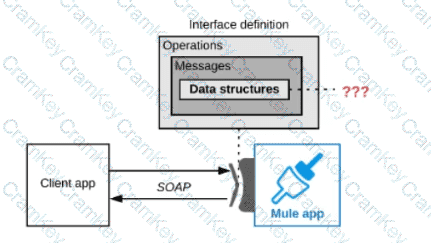
Refer to the exhibit.

A Mule application is being designed to expose a SOAP web service to its clients.

What language is typically used inside the web service's interface definition to define the data structures that the web service Is expected to exchange with its clients?

Questions 71

Options:

A.

WSDL

B.

XSD

C.

JSON Schema

D.

RAMI

Discussion
Norah
Cramkey is highly recommended.
Zayan Nov 16, 2025
Definitely. If you're looking for a reliable and effective study resource, look no further than Cramkey Dumps. They're simply wonderful!
Anya
I must say they're considered the best dumps available and the questions are very similar to what you'll see in the actual exam. Recommended!!!
Cassius Nov 4, 2025
Yes, they offer a 100% success guarantee. And many students who have used them have reported passing their exams with flying colors.
Erik
Hey, I have passed my exam using Cramkey Dumps?
Freyja Nov 13, 2025
Really, what are they? All come in your pool? Please give me more details, I am going to have access their subscription. Please brother, give me more details.
Pippa
I was so happy to see that almost all the questions on the exam were exactly what I found in their Dumps.
Anastasia Nov 10, 2025
You are right…It was amazing! The Cramkey Dumps were so comprehensive and well-organized, it made studying for the exam a breeze.
Page: 17 / 20
Title
Questions
Posted

MuleSoft-Integration-Architect-I
PDF

$26.25  $104.99

MuleSoft-Integration-Architect-I Testing Engine

$31.25  $124.99

MuleSoft-Integration-Architect-I PDF + Testing Engine

$41.25  $164.99

