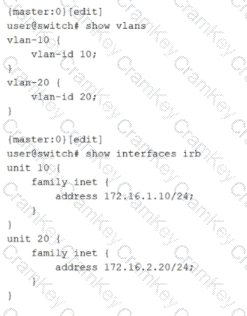
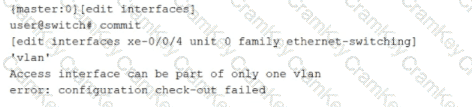
The commit error indicates that the interface is being treated as an access port while the configuration attempts to associate it with more than one VLAN. In Junos Ethernet switching, an access mode interface represents a single untagged VLAN membership. Because access ports accept and transmit frames without 802.1Q tags, the switch must map all ingress untagged traffic to exactly one VLAN. For that reason, Junos enforces the rule that an access interface can be part of only one VLAN, and it rejects configurations that try to add multiple VLAN members under access mode.
There are two valid ways to resolve this, depending on the intended design. First, if the port truly connects to a single endpoint that should live in only one broadcast domain, configure the interface as a member of only one VLAN. This aligns with access port semantics and eliminates the conflict that causes the commit to fail.
Second, if the endpoint or downstream device needs to carry multiple VLANs over the same physical link, change the interface to trunk mode. A trunk port is designed to transport multiple VLANs using 802.1Q tagging, so multiple VLAN members are valid and expected. In data center environments, trunking is common for server virtualization hosts, appliance uplinks, and switch-to-switch links.
Connecting the interface to the network does not affect configuration validation, and logical unit numbering is unrelated to VLAN membership rules for access ports.