Virtualization Technology
Description
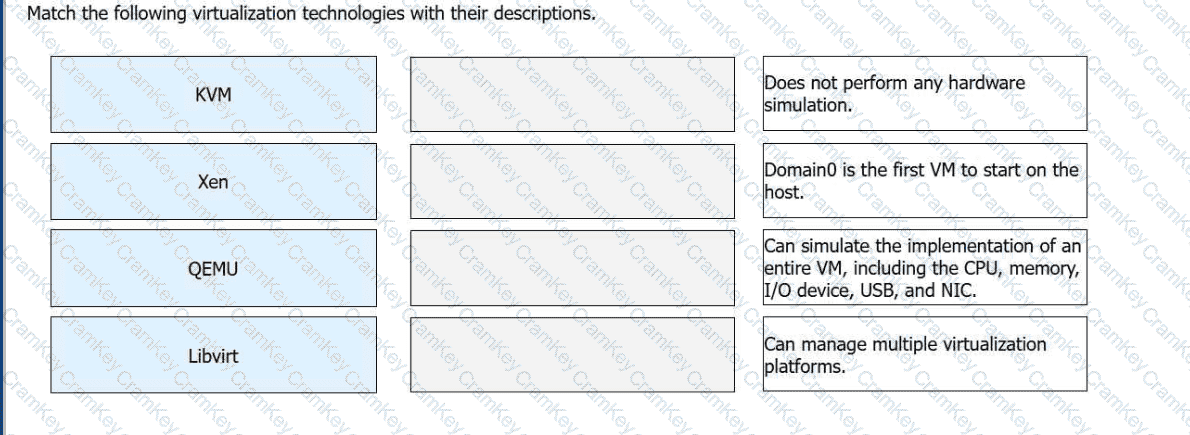
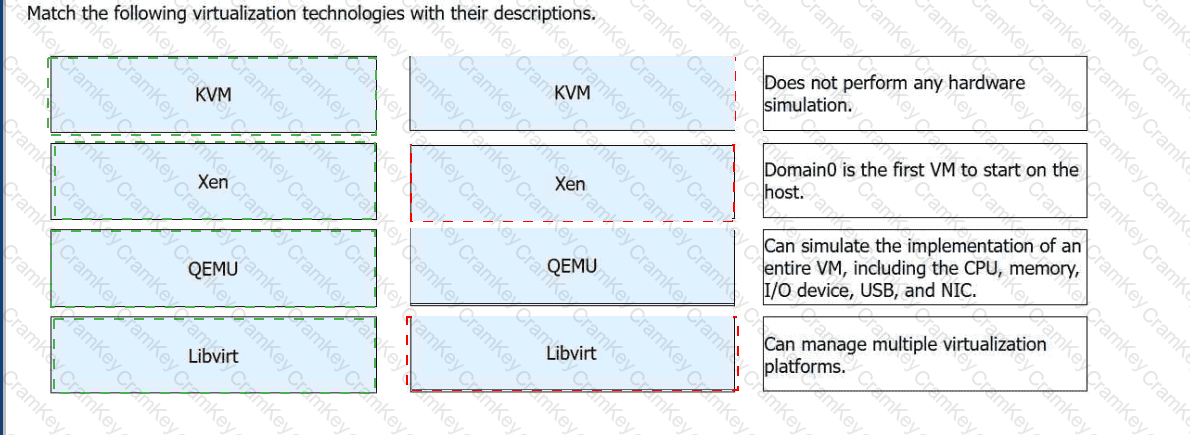
KVM
Does not perform any hardware simulation.
Xen
Domain0 is the first VM to start on the host.
QEMU
Can simulate the implementation of an entire VM, including the CPU, memory, I/O device, USB, and NIC.
Libvirt
Can manage multiple virtualization platforms.
Huawei's technical materials differentiate between these technologies based on their specific roles within the virtualization ecosystem.KVM (Kernel-based Virtual Machine)is an open-source module within the Linux kernel. While it provides the core virtualization capabilities for CPU and memory, it is defined in the HCIA curriculum as a technology thatdoes not perform hardware simulationitself. Instead, it typically relies on hardware-assisted virtualization or integrates with other tools to handle I/O operations.
Xenis a Type-1 hypervisor that operates directly on the hardware. A unique feature of the Xen architecture isDomain0, which is a privileged virtual machine that starts first and provides the management environment and drivers for other guest VMs (DomainU). In contrast,QEMUis a pure software-based emulator. It is powerful because itcan simulate an entire VM, including all peripherals like the CPU, NIC, and USB. However, because it relies on software simulation, its performance is lower than hardware-assisted technologies unless it is used as a backend for KVM.
Finally,Libvirtserves as the universal management layer. It is a set of open-source library functions and APIs that allow administrators tomanage multiple virtualization platforms(including KVM, Xen, and VMware) using a standardized command set. It provides transparency to upper-layer management software by abstracting the complexities of the underlying hypervisor. Understanding how these technologies interact—such as KVM utilizing Libvirt for management and QEMU for I/O—is a critical learning objective for candidates preparing for the Huawei H13-511 exam.