Pre-Winter Sale Limited Time 65% Discount Offer - Ends in 0d 00h 00m 00s - Coupon code: get65

VMware Updated 3V0-23.25 Exam Questions and Answers by jonathan

Page: 4 / 5

VMware 3V0-23.25 Exam Overview :

Exam Name: Advanced VMware Cloud Foundation 9.0 Storage
Exam Code: 3V0-23.25 Dumps
Vendor: VMware Certification: VCAP-Storage
Questions: 77 Q&A's Shared By: jonathan
Question 16

An administrator is working on a VMware Cloud Foundation (VCF) Workload Domain that was configured to use vSAN for principal storage. The administrator wishes to create and configure a datastore cluster to host tenant VMs using that vSAN backed storage across multiple clusters, mixed OSA and ESA, in the domain.

What should the administrator consider?

Options:

A.

When using vSAN datastores, Datastore Clusters are not supported. Each VM must be placed manually on the vSAN datastore.

B.

When using vSAN as the underlying datastore, an administrator must create the datastore cluster via vCenter APIs, include the vSAN datastore(s) in it, enable Storage DRS, and ensure the VM Storage Policies reference the appropriate vSAN-capable datastore.

C.

A datastore cluster can combine different storage types, such as vSAN, FC, and NFS datastores, as long as they are in the same vCenter; Storage DRS will treat them uniformly.

D.

vSAN OSA and ESA based datastores must be added to a datastore cluster tag and then selected as part of a single storage policy.

Discussion
Question 17

A firm is migrating to VMware Cloud Foundation (VCF) and will leverage its existing enterprise Fibre Channel SAN for workload domain storage.

Their priorities include seamless integration into VCF, automated lifecycle management via VCF Operations, consistent VM-level performance control, and alignment with best practices for large-scale VI environments. Management does not require vSAN, and operational simplicity is critical.

Which design meets all of the specified requirements?

Options:

A.

Dedicate FC LUNs to the Management Domain only, and utilize local SSD and HDD drives in each VI workload domain for operational workloads with automatic VM placement.

B.

Designate VMFS datastores on the existing FC SAN as principal storage for each workload domain, then assign multiple Storage Policies based on array and LUN performance tiers to enable automated VM placement and enforce QoS.

C.

Mount a single, high-capacity vSAN datastore from the existing storage solution to all clusters and automatically allocate VMs to this datastore, and let the array handle VM-level performance control.

D.

Import FC LUNs into the management cluster as vVol datastores for each workload domain, then assign multiple Storage Policies based on array and LUN performance tiers to enable automated VM placement and enforce QoS.

Discussion
Victoria
Hey, guess what? I passed the certification exam! I couldn't have done it without Cramkey Dumps.
Isabel Aug 17, 2026
Same here! I was so surprised when I saw that almost all the questions on the exam were exactly what I found in their study materials.
Sam
Can I get help from these dumps and their support team for preparing my exam?
Audrey Aug 24, 2026
Definitely, you won't regret it. They've helped so many people pass their exams and I'm sure they'll help you too. Good luck with your studies!
Norah
Cramkey is highly recommended.
Zayan Aug 17, 2026
Definitely. If you're looking for a reliable and effective study resource, look no further than Cramkey Dumps. They're simply wonderful!
Pippa
I was so happy to see that almost all the questions on the exam were exactly what I found in their Dumps.
Anastasia Aug 24, 2026
You are right…It was amazing! The Cramkey Dumps were so comprehensive and well-organized, it made studying for the exam a breeze.
Question 18

An administrator is responsible for managing a VMware Cloud Foundation (VCF) Private Cloud.

The following information has been provided about the environment:

• There are 3 customer datacenters, Site A, Site B and Site C.

• The datacenter at Site A runs all Production Services.

• The datacenter at Site B has reached capacity and there is no space for additional physical hardware.

• The datacenter at Site C has been commissioned to replace Site B, because there is more rack space and power capacity to cater for future demand.

The administrator has been tasked with identifying the networking requirements for a new VMware vSAN Stretched Cluster with the following requirements:

• The solution will deploy a total of 10 new ESX host servers to create a VMware vSAN Stretched Cluster.

• The solution must deploy appropriate networking to ensure minimal disruption from issues with Spanning Tree Protocol (STP).

Drag and drop the correct vSAN Site Type, Networking Type and Round Trip Latency (RTT) within the boxes provided to complete the high-level diagram.
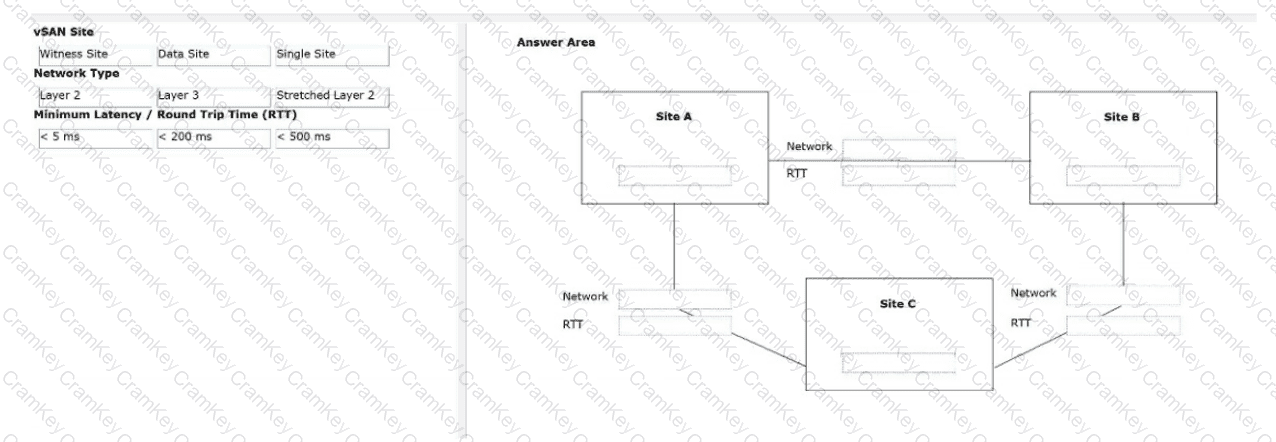
Questions 18

Options:

Discussion
Question 19

An administrator just built a new workload domain including a vSAN ESA cluster. The architecture design included the use of memory tiering and a specific smaller NVMe device has been installed in each ESX host for this purpose.

When looking in the vSphere UI, the administrator notices that the device intended to be used for memory tiering has been claimed by vSAN.

What action should be taken on each host to achieve the desired configuration?

Options:

A.

Boot the host one time with the tiering device removed, then shut down again. Reconnect the tiering device and boot the host.

B.

Change vSAN disk claiming from automatic to manual and sequentially reboot each ESX host of the cluster after putting them in maintenance mode using the “Ensure Accessibility” option.

C.

After turning on the LED on the memory tiering device, hot remove it from the ESX host; vSAN will rebuild the required objects.

D.

Remove the device from vSAN performing a full data migration and configure that device for memory tiering.

Discussion
Page: 4 / 5

3V0-23.25
PDF

$36.75  $104.99

3V0-23.25 Testing Engine

$43.75  $124.99

3V0-23.25 PDF + Testing Engine

$57.75  $164.99