| Exam Name: | Implementing Analytics Solutions Using Microsoft Fabric | ||
| Exam Code: | DP-600 Dumps | ||
| Vendor: | Microsoft | Certification: | Microsoft Certified: Fabric Analytics Engineer Associate |
| Questions: | 209 Q&A's | Shared By: | kamil |
You have a Fabric tenant that contains a semantic model named Modell.
Model1 contains a table named TemperatureUnit. TemperatureUnit contains a column named Unit. Unit contains manually added options foe Celsius and Fahrenheit.
Modell contains the following, measures:
A measure that contains the following expression.
A measure that contains the following expression:
[TemperatureMetric] = AVERAGE(Weather[TempC] )
A dynamic measure that contains the following expression:
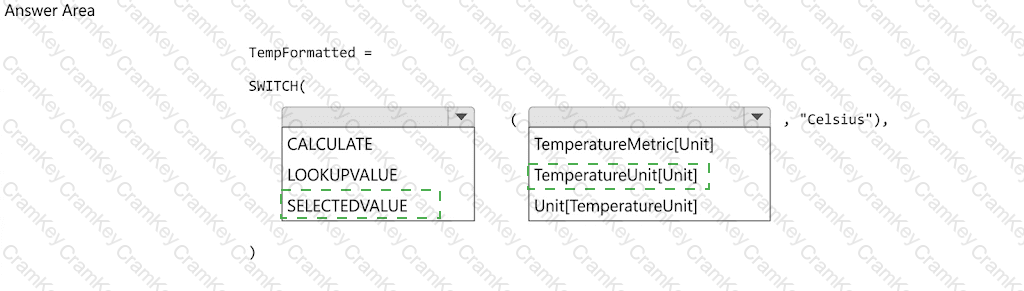
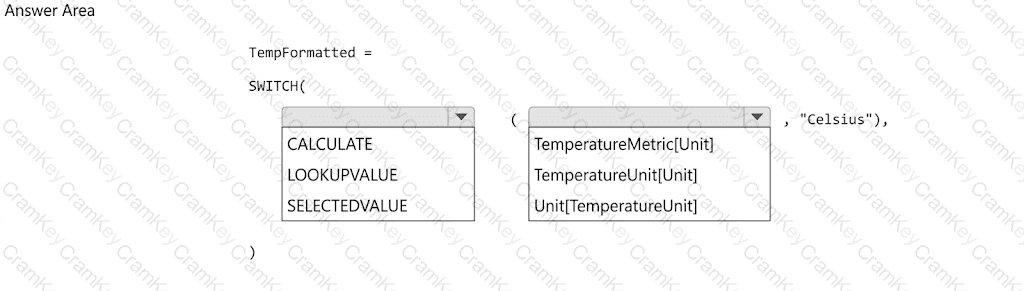
[TemperatureDisplay] = VAR Unit = SELECTEDVALUE(TemperatureUnit[Unit] , " Celsius " ) VAR CelsiusValue = [TemperatureMetric] RETURN SWITCH( Unit, " Fahrenheit " , (CelsiusValue * 9/5) + 32, CelsiusValue )
You need to add a dynamic format string to the [TemperatureDisplay] measure to enable users to switch display values between metric (Celsius) and imperial (Fahrenheit).
How should you complete the DAX expression? To answer, select the appropriate options in the answer area.
NOTE: Each correct selection is worth one point.
You have a Fabric tenant that contains a lakehouse. You plan to use a visual query to merge two tables.
You need to ensure that the query returns all the rows that are present in both tables. Which type of join should you use?
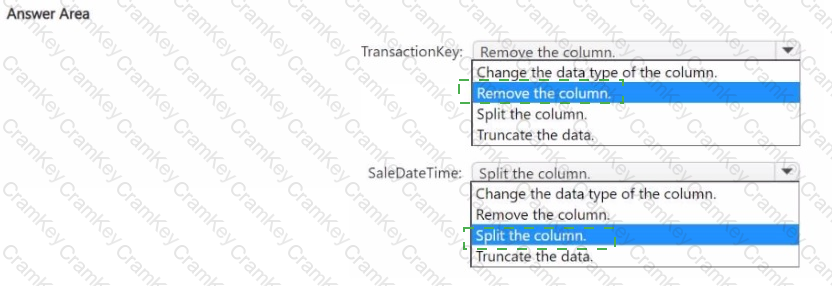
You have a Fabric tenant that contains a semantic model named model1. The two largest columns in model1 are shown in the following table.
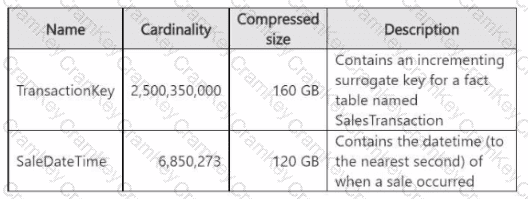
You need to optimize model 1. The solution must meet the following requirements:
• Reduce the model size.
• Increase refresh performance when using Import mode.
• Ensure that the datetime value for each sales transaction is available in the model.
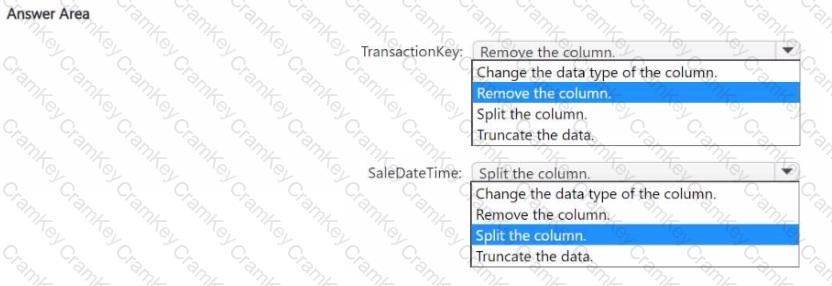
What should you do on each column? To answer, select the appropriate options in the answer area.
NOTE: Each correct selection is worth one point.
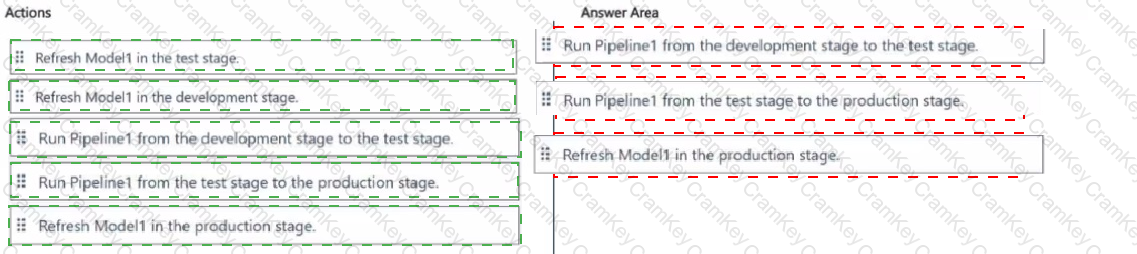
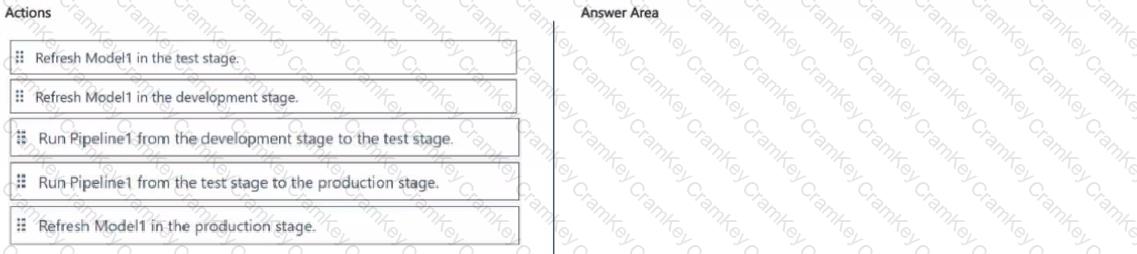
You have three Fabric workspaces named Workspace1, Workspace2, and Workspace3 Workspace1 contains a report named Report1 and a semantic model named Model1 in import mode.
You perform the following actions;
• Create a deployment pipeline named Pipeline1 that has three stages named development, test, and production.
• Assign Workspace1 to the development stage of Pipeline1.
• Assign Workspace2 to the test stage of Pipeline.
• Assign Wofkspace3 to the production stage of Pipeline1
• Modify Model1.
You need to ensure that changes to Model! are available in the production stage as quickly as possible. The solution must NOT affect the availability of Report1.
Which three actions should you perform in sequence? To answer, move the appropriate actions from the list of actions to the answer area and arrange them in the correct order.

TESTED 23 Oct 2026