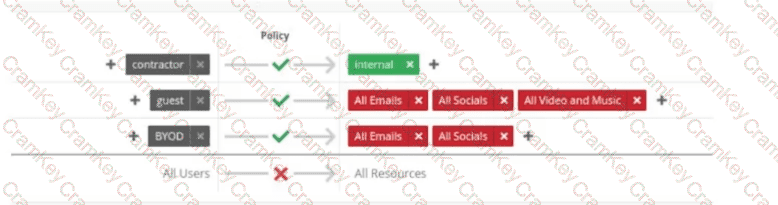
In Juniper Networks Mist AI Wireless, WxLAN policies are evaluated using a top-down, first-match logic. This means that when traffic matches a policy condition, that policy is applied immediately, and no further policies are evaluated. Understanding this evaluation order is critical when troubleshooting access discrepancies between user types such as BYOD and guest users.
From the scenario and the exhibit, guest devices are able to access youtube.com, while BYOD devices are blocked. This indicates that:
The guest WxLAN policy allows “All Video and Music” traffic (which includes YouTube).
The BYOD WxLAN policy blocks “All Video and Music” traffic.
The BYOD policy is evaluated before the guest policy.
Because BYOD users are matched to the BYOD label, their traffic hits the BYOD policy first and is denied before it can reach the more permissive guest policy. Simply modifying labels or deleting policies is unnecessary and could introduce unintended access control issues.
The correct and least disruptive solution is to move the BYOD WxLAN policy above the guest policy and then adjust the BYOD policy rules (for example, allowing YouTube or the “All Video and Music” category). By reordering the policies, you ensure that BYOD traffic is evaluated correctly and receives the intended permissions without impacting guest access.
The incorrect options are explained as follows:
Deleting policies (Options A and C) is not best practice and risks breaking segmentation and access control.
Option B is irrelevant, as the contractor policy does not affect BYOD or guest traffic in this scenario.
Therefore, the correct solution is to move the WxLAN policy for BYOD above the policy for guests, making Option D the correct answer.


 Text
Description automatically generated with low confidence
Text
Description automatically generated with low confidence