| Exam Name: | HPE Network Security Expert Written Exam | ||
| Exam Code: | HPE7-A10 Dumps | ||
| Vendor: | HP | Certification: | Aruba Certified Switching Expert |
| Questions: | 75 Q&A's | Shared By: | kaia |
A company wants its AOS-CX switches to obtain certificates from ClearPass Onboard and use those certificates to implement RadSec with ClearPass Policy Manager (CPPM).
ClearPass Onboard has a CA with EST enabled and this EST URL: `[https://cp1.acnsxtest.com/.well-known/est/ca:2](https://cp1.acnsxtest.com/.well-known/est/ca:2)`
ClearPass Guest has an account whose username is `switchcorp123`. (Assume CPPM also has a valid service to authenticate users who access the EST application.)
CPPM has a network-device account for the switches with RadSec enabled. The RadSec settings validate by CN or SAN using this regex: `switchcorp123`
ClearPass has these certificates:
* HTTPS certificate signed by DigiCert
* RadSec certificate signed by DigiCert
* RADIUS/EAP certificate signed by MyDomainCA
This configuration is on the AOS-CX switches:
```text
crypto pki est-profile est1
url https://clearpass1.acnsxtest.com/.well-known/est/ca:2
username switchcorp123
password plaintext %FY212h & zaTk
vrf default
exit
crypto pki certificate cert1
subject switchcorp123
enroll est-profile onboard
crypto pki application radsec-client certificate cert1
```
The switches’ TA-profile list includes DigiCert.
Assume you have obtained the correct password associated with the indicated username. What error or errors are present?
When should BPDU protection be implemented on an AOS-CX switch port rather than BPDU filtering?
A customer is migrating from on-premises AD to Microsoft Entra ID (Azure AD) as its only domain solution. The customer also manages wired and wireless devices with Microsoft Endpoint Manager (Intune).
The customer wants to strengthen network-edge security. You are assisting with the design of an HPE Aruba Networking ClearPass deployment for this purpose. HPE Aruba Networking devices will authenticate wireless and wired clients to a ClearPass Policy Manager (CPPM) cluster that uses version 6.10.
The customer has several authentication requirements. Clients should pass EAP-TLS authentication only when a query to Microsoft Entra ID (Azure AD) confirms that they have accounts in Microsoft Entra ID (Azure AD). To further refine client privileges, ClearPass must also use information gathered by Intune to make access-control decisions.
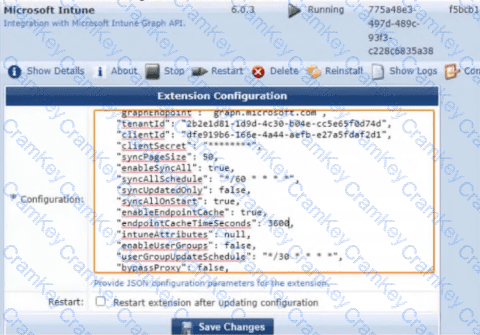
Extension Configuration:
graphEndpoint: graph.microsoft.com
syncPageSize: 50
enableSyncAll: true
syncAllSchedule: "*/60 * * * *"
syncUpdatedOnly: false
syncAllOnStart: true
enableEndpointCache: true
endpointCacheTimeSeconds: 3600
enableUserGroups: false
Refer to the scenario.
The Intune extension is configured as shown in this exhibit.
The customer wants to reduce the overhead of polling information from Intune to CPPM, but requires client information to be current at least once per hour. What should you recommend?
Refer to the exhibit.
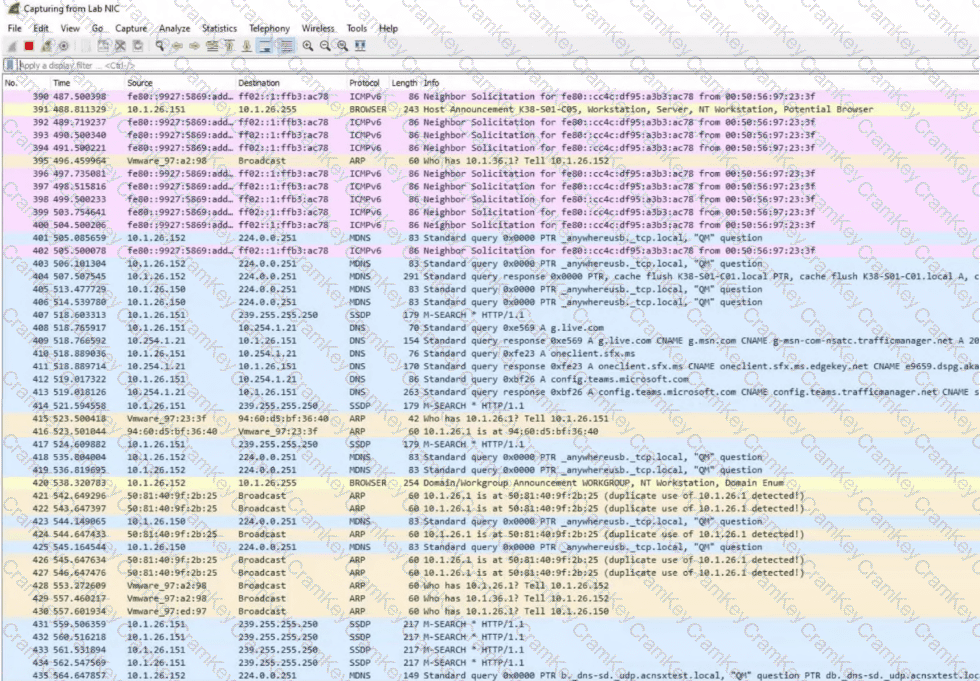
Frame 421: 50:81:40:9f:2b:25 - > Broadcast ARP 60 10.1.26.1 is at 50:81:40:9f:2b:25 (duplicate use of 10.1.26.1 detected!)
Frame 422: 50:81:40:9f:2b:25 - > Broadcast ARP 60 10.1.26.1 is at 50:81:40:9f:2b:25 (duplicate use of 10.1.26.1 detected!)
Frame 424: 50:81:40:9f:2b:25 - > Broadcast ARP 60 10.1.26.1 is at 50:81:40:9f:2b:25 (duplicate use of 10.1.26.1 detected!)
Which device should be documented as potentially malicious and requiring further investigation?

TESTED 16 Nov 2026