Spring Sale Limited Time 65% Discount Offer - Ends in 0d 00h 00m 00s - Coupon code: get65

Google Updated Professional-Cloud-DevOps-Engineer Exam Questions and Answers by junior

Page: 3 / 14

Google Professional-Cloud-DevOps-Engineer Exam Overview :

Exam Name: Google Cloud Certified - Professional Cloud DevOps Engineer Exam
Exam Code: Professional-Cloud-DevOps-Engineer Dumps
Vendor: Google Certification: Cloud DevOps Engineer
Questions: 201 Q&A's Shared By: junior
Question 12

You are leading a DevOps project for your organization. The DevOps team is responsible for managing the service infrastructure and being on-call for incidents. The Software Development team is responsible for writing, submitting, and reviewing code. Neither team has any published SLOs. You want to design a new joint-ownership model for a service between the DevOps team and the Software Development team. Which responsibilities should be assigned to each team in the new joint-ownership model?
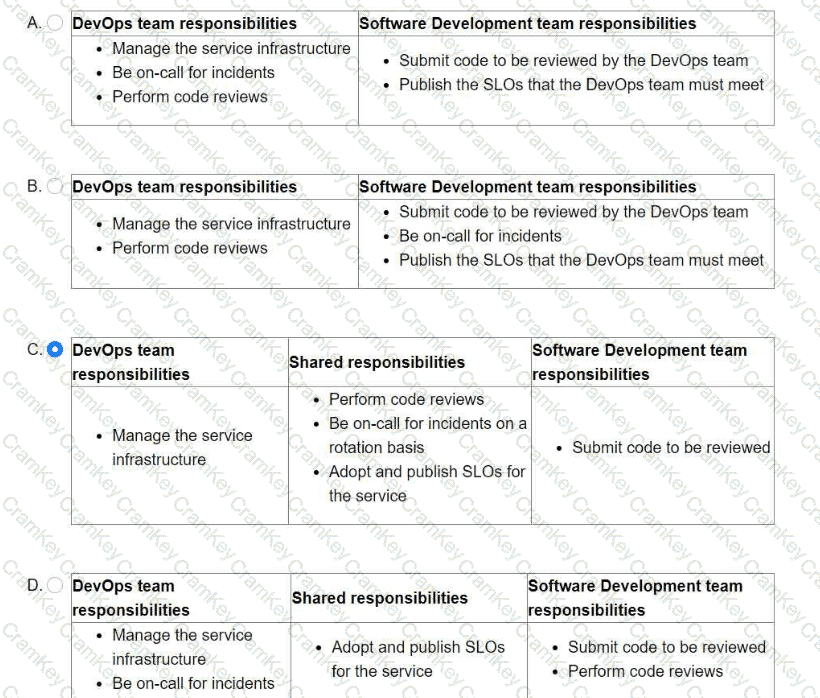
Questions 12

Options:

A.

Option A

B.

Option B

C.

Option C

D.

Option D

Discussion
Question 13

Your team uses Cloud Build for all CI/CO pipelines. You want to use the kubectl builder for Cloud Build to deploy new images to Google Kubernetes Engine (GKE). You need to authenticate to GKE while minimizing development effort. What should you do?

Options:

A.

Assign the Container Developer role to the Cloud Build service account.

B.

Specify the Container Developer role for Cloud Build in the cloudbuild.yaml file.

C.

Create a new service account with the Container Developer role and use it to run Cloud Build.

D.

Create a separate step in Cloud Build to retrieve service account credentials and pass these to kubectl.

Discussion
Question 14

You are designing a new Google Cloud organization for a client. Your client is concerned with the risks associated with long-lived credentials created in Google Cloud. You need to design a solution to completely eliminate the risks associated with the use of JSON service account keys while minimizing operational overhead. What should you do?

Options:

A.

Use custom versions of predefined roles to exclude all iam.serviceAccountKeys. * service account role permissions.

B.

Apply the constraints/iam.disableserviceAccountKeycreation constraint to the organization.

C.

Apply the constraints/iam. disableServiceAccountKeyUp10ad constraint to the organization.

D.

Grant the roles/ iam.serviceAccountKeyAdmin IAM role to organization administrators only.

Discussion
Neve
Will I be able to achieve success after using these dumps?
Rohan Feb 5, 2026
Absolutely. It's a great way to increase your chances of success.
Honey
I highly recommend it. They made a big difference for me and I'm sure they'll help you too. Just make sure to use them wisely and not solely rely on them. They should be used as a supplement to your regular studies.
Antoni Feb 13, 2026
Good point. Thanks for the advice. I'll definitely keep that in mind.
Josie
I just passed my certification exam using their dumps and I must say, I was thoroughly impressed.
Fatimah Feb 10, 2026
You’re right. The dumps were authentic and covered all the important topics. I felt confident going into the exam and it paid off.
Robin
Cramkey is highly recommended.
Jonah Feb 9, 2026
Definitely. If you're looking for a reliable and effective study resource, look no further than Cramkey Dumps. They're simply wonderful!
Norah
Cramkey is highly recommended.
Zayan Feb 7, 2026
Definitely. If you're looking for a reliable and effective study resource, look no further than Cramkey Dumps. They're simply wonderful!
Question 15

You are responsible for the reliability of a custom-built, distributed file storage service that your company uses internally. This service handles thousands of file uploads and downloads daily. You need to define a service level indicator (SLI) to measure the reliability of your service usage and configure alerts to be notified of potential issues. Which SLI should you use to measure the reliability of the service?

Options:

A.

Average request latency of API calls (e.g. get, put, list)

B.

Average size of objects stored in your service

C.

Ratio of successful API calls to the total number of attempted API calls

D.

Number of successful file uploads and downloads per minute

Discussion
Page: 3 / 14
Title
Questions
Posted

Professional-Cloud-DevOps-Engineer
PDF

$36.75  $104.99

Professional-Cloud-DevOps-Engineer Testing Engine

$43.75  $124.99

Professional-Cloud-DevOps-Engineer PDF + Testing Engine

$57.75  $164.99