Comprehensive and Detailed Explanation From Exact Extract (NCC-Recommended Sources Only)
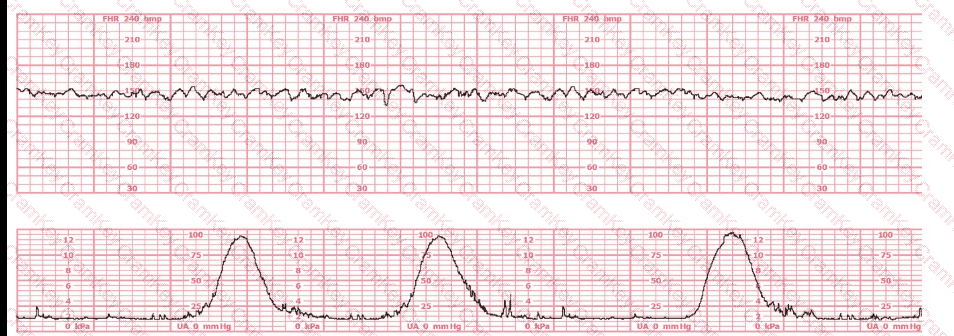
The fetal heart rate (FHR) tracing shown demonstrates a baseline approximately 135–145 bpm with fluctuations of 6–25 bpm, a hallmark of moderate variability. Moderate variability is defined in all NCC-endorsed resources as the normal amplitude range of 6–25 bpm around the fetal baseline.
According to the AWHONN Fetal Heart Monitoring Principles & Practices (2022–2024), moderate variability is considered the single most reliable indicator of adequate fetal oxygenation and intact neurologic pathways, specifically reflecting well-functioning sympathetic and parasympathetic interplay.
The NICHD/NCC standardized definitions included in the NCC C-EFM Candidate Guide state:
Minimal variability: amplitude range ≤ 5 bpm
Moderate variability: amplitude range 6–25 bpm
Marked variability: amplitude > 25 bpm
Sinusoidal pattern: smooth, undulating waveform, 3–5 cycles per minute, equal amplitude, absent beat-to-beat variability
The tracing provided does not show the repetitive, smooth, wave-like pattern of a sinusoidal rhythm; nor does it show flattening associated with minimal variability. Instead, it includes continuous beat-to-beat fluctuation within the moderate range, without periods of absent or minimal variability.
Menihan’s Electronic Fetal Monitoring (5th ed.) and Simpson & Creehan’s Perinatal Nursing (5th ed.) both emphasize that moderate variability is:
A reassuring feature
Indicative of adequate fetal CNS oxygenation
Expected in a reactive, well-oxygenated fetus
A key criterion for Category I classification
Additionally, Miller’s EFM Pocket Guide reiterates that variability between 6–25 bpm is considered the normal (moderate) fetal autonomic response and is not a sinusoidal pattern, which has a fixed amplitude and frequency.
Therefore, based on NCC-standard definitions and the observed amplitude, the correct interpretation is moderate variability.
References (No URLs):
AWHONN Fetal Heart Monitoring Principles & Practices; NCC C-EFM Candidate Guide 2025; Simpson & Creehan Perinatal Nursing; Menihan Electronic Fetal Monitoring; Miller’s Pocket Guide to Fetal Monitoring; Creasy & Resnik Maternal-Fetal Medicine.