| Exam Name: | Operationalizing Machine Learning and Generative AI Solutions | ||
| Exam Code: | AI-300 Dumps | ||
| Vendor: | Microsoft | Certification: | Microsoft Certified: Machine Learning Operations (MLOps) Engineer |
| Questions: | 187 Q&A's | Shared By: | zunaira |
You manage an Azure Machine Learning workspace named Workspace1.
You plan to create a pipeline in the Azure Machine Learning Studio designer. The pipeline must include a custom component You need to ensure the custom component can be used in the pipeline. What should you do first.
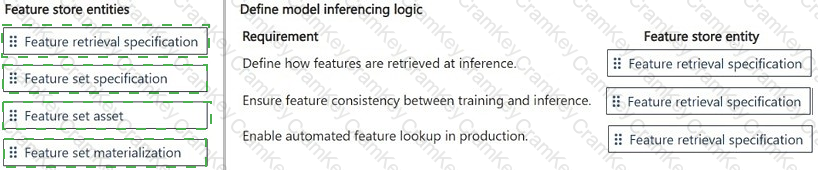
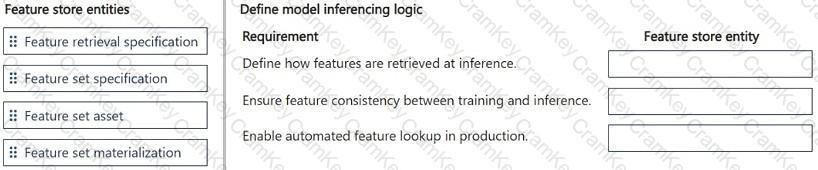
A data science team trains a model that depends on features that are stored in a managed feature store.
The model is registered in Azure Machine Learning and will be deployed to a real-time endpoint.
After deployment, the model must:
• Retrieve feature values dynamically at inference time.
• Use the same feature definitions that were used during training.
• Run without manual configuration changes across environments.
You need to define feature store entities so that feature retrieval behaves as expected when the model is deployed.
Which feature store entity should you select for each requirement? To answer, move the appropriate feature store entities to the correct requirements. You may use each feature store entity once, more than once, or not at all. You may need to move the split bar between panes or scroll to view content.
NOTE: Each correct selection is worth one point.
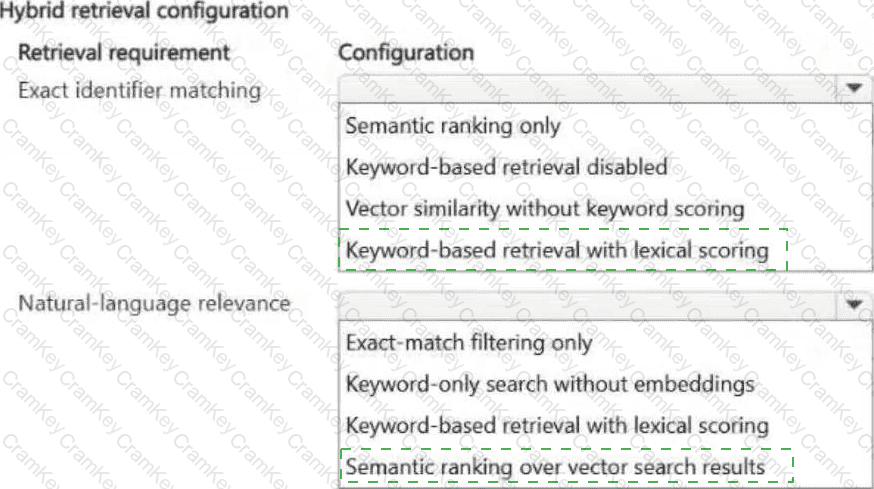
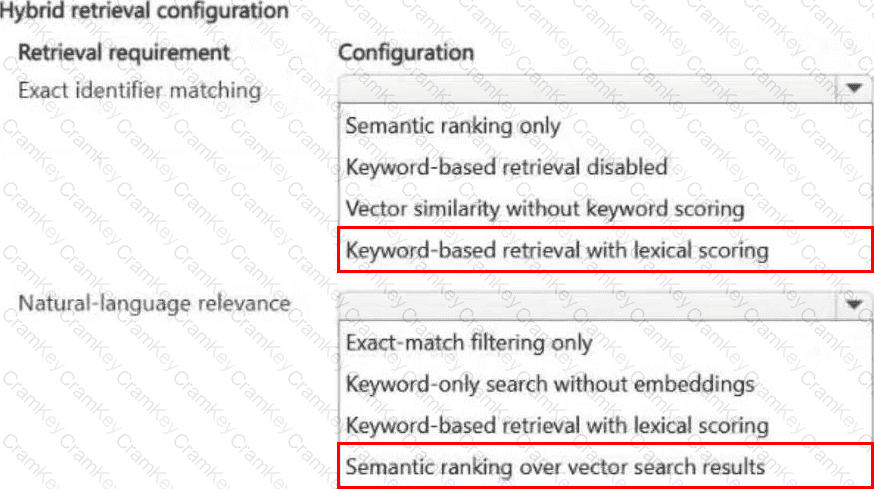
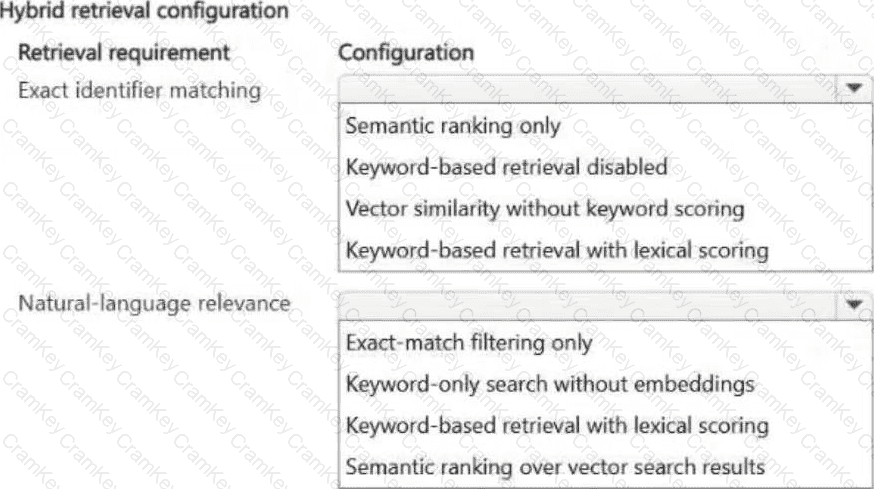
You manage a Retrieval-Augmented Generation (RAG) system that uses Azure AI Search to retrieve documents from an indexed knowledge base.
The system must support the following retrieval requirements:
Queries that include exact policy identifiers must return matching documents even when semantic similarity is low.
Natural-language questions must prioritize semantically relevant documents even when keywords are not an exact match.
You need to configure the retrieval approach to meet the requirements.
How should you configure the retrieval behavior for each requirement? To answer, select the appropriate options in the answer area. NOTE: Each correct selection is worth one point.
You create an Azure Machine Learning workspace.
You must configure an event-driven workflow to automatically trigger upon completion of training runs in the workspace. The solution must minimize the administrative effort to configure the trigger.
You need to configure an Azure service to automatically trigger the workflow.
Which Azure service should you use?

TESTED 14 Sep 2026