Administering Windows Server
Last Update Sep 20, 2026
Total Questions : 510
To help you prepare for the AZ-802 Microsoft exam, we are offering free AZ-802 Microsoft exam questions. All you need to do is sign up, provide your details, and prepare with the free AZ-802 practice questions. Once you have done that, you will have access to the entire pool of Administering Windows Server AZ-802 test questions which will help you better prepare for the exam. Additionally, you can also find a range of Administering Windows Server resources online to help you better understand the topics covered on the exam, such as Administering Windows Server AZ-802 video tutorials, blogs, study guides, and more. Additionally, you can also practice with realistic Microsoft AZ-802 exam simulations and get feedback on your progress. Finally, you can also share your progress with friends and family and get encouragement and support from them.
Note: This question is part of a series of questions that present the same scenario. Each question in the series contains a unique solution that might meet the stated goals. You are planning the deployment of DNS to a new network. You have three internal DNS servers as shown in the following exhibit (Server1/Montreal/10.0.1.10/contoso.local, Server2/Toronto/10.0.2.10/east.contoso.local, Server3/Seattle/10.0.3.10/west.contoso.local). The contoso.local zone contains zone delegations for east.contoso.local and west.contoso.local. All the DNS servers use root hints. You need to ensure that all the DNS servers can resolve the names of all the internal namespaces and internet hosts. Solution: On Server2 and Server3, you configure a conditional forwarder for contoso.local. Does this meet the goal?

Server1 (Montreal, 10.0.1.10, contoso.local) / Server2 (Toronto, 10.0.2.10, east.contoso.local) / Server3 (Seattle, 10.0.3.10, west.contoso.local); contoso.local delegates east.contoso.local and west.contoso.local.
You have an Azure virtual machine named VM1 that runs Windows Server. You have an Azure subscription that has Microsoft Defender for Cloud enabled. You need to ensure that you can use the Azure Policy guest configuration feature to manage VM1. What should you do?
Technical requirements: Promote a new server named DC4 that runs Windows Server 2022 to a domain controller. Replicate the virtual machines from Cluster2 to an Azure Recovery Services vault. Centrally manage performance alerts in Azure for all the domain controllers. Ensure that User1 can recover objects from the Active Directory Recycle Bin. Migrate Share1 to Server2, including all the share and folder permissions. Back up Server4 and all data to an Azure Recovery Services vault. Use Hyper-V Replica to protect the virtual machines in Cluster3. Implement BitLocker Drive Encryption (BitLocker) on Server4. Whenever possible, use the principle of least privilege. You need to meet the technical requirements for Cluster3. What should you include in the solution?
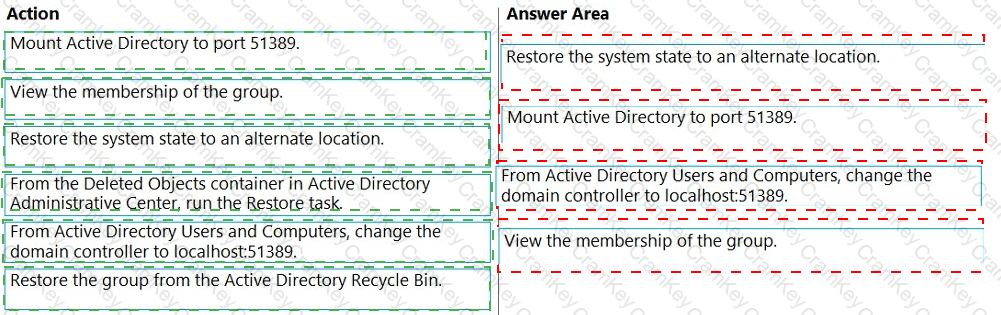
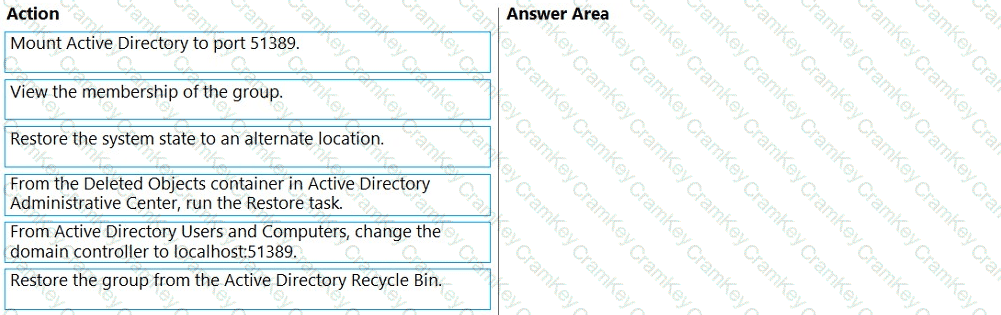
Your network contains an Active Directory Domain Services (AD DS) domain that has the Active Directory Recycle Bin enabled. All domain controllers are backed up daily. You accidentally remove all the users from a domain group. You need to get a list of the users that were previously in the group. Which four actions should you perform in sequence from a domain controller? To answer, move the appropriate actions from the list of actions to the answer area and arrange them in the correct order.

TESTED 20 Sep 2026